
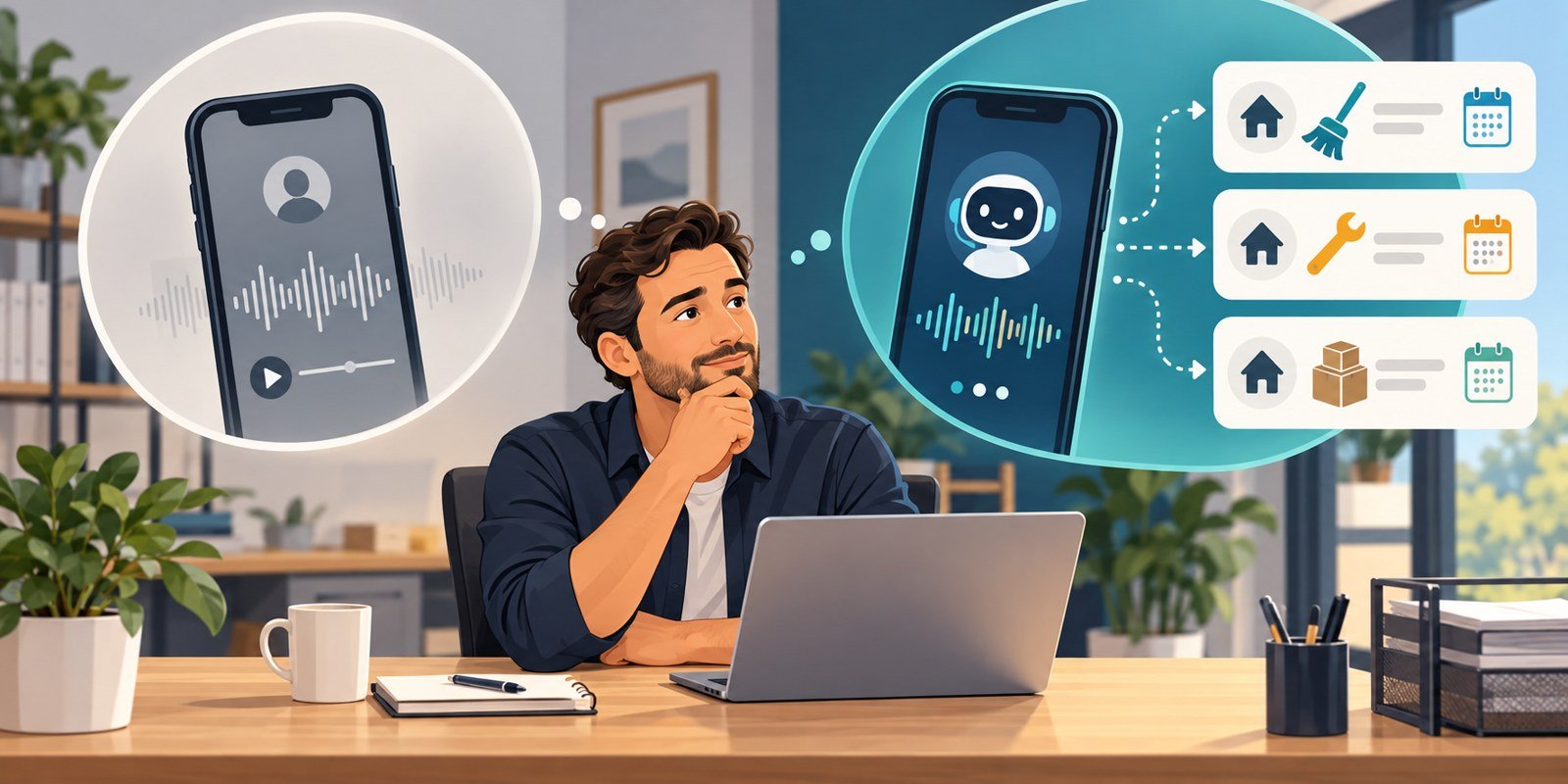
The phone rings while your team is working in a customer’s home. You cannot answer without stopping the job. Should that call go to voicemail, or should an AI receptionist handle the conversation?
Both can be useful. The choice depends on what needs to happen before your team returns the call, how predictable the requests are, and which decisions require a person. Compare the complete workflow rather than choosing only by how the voice sounds.
What voicemail does well
Voicemail gives the caller a place to leave a message in their own words. It can work well when the business wants a person to review every request, when calls are infrequent, or when an unusual job needs a detailed conversation before scheduling.
A useful greeting tells customers what information to leave and what happens next. Ask for a name, callback number, service location, and brief description of the work. Only state a callback deadline if your business can meet it. Give existing customers a clear way to identify an appointment question.
The limitation is that the greeting cannot ask a question after hearing the message. If the customer leaves out the address or says only “I need cleaning,” someone must obtain the missing details later. A recording preserves what the caller said, but it does not by itself establish that the request is ready to book.
What an AI receptionist can add
An AI receptionist can ask follow up questions during the call. For a service business, those questions should establish what work is requested, the quantities involved, the reported problem, the location, and the customer’s desired next step.
Nearby Booker Voice AI collects primary and secondary services, quantities, problems, configured extras, and follow up choices. Its usefulness depends on the information your business provides and the behavior you verify in test calls. A natural voice does not prove that the final record is complete.
For more detail, see how service categories guide Voice AI conversations. Clear categories help distinguish carpet cleaning from upholstery cleaning while keeping both requests in the same conversation.
Compare a real type of service request
Suppose a caller says, “I need 1,200 square feet of carpet cleaned, and there is a urine smell in one room. Can you also clean my sofa?”
With voicemail, that message gives your team a useful starting point. A person can listen, ask about the sofa, explain any treatment options, collect the address, and decide whether the appointment fits. The quality of the outcome depends on the callback and the notes recorded afterward.
With an AI receptionist, the conversation can continue immediately. The assistant should retain the carpet quantity while collecting the sofa details. If the business has configured liquid and foam enzyme options, it should use the supplied explanations and record the customer’s choice. Discussing an extra is different from agreeing to it.
Neither workflow should promise a cleaning result based solely on a phone description. The carpet cleaning intake checklist provides a practical way to test whether the details stay attached to the right service.
Decide which calls need human review
Some callers want to book. Others want an estimate, an explanation, a change to an existing appointment, or help with a complaint. Those are different next steps.
Define when the assistant should stop making a booking decision and preserve the request for a person. Examples include an unsupported service, an uncertain scope, a question outside the supplied information, or a customer who asks for human help. The next step must match a workflow your business actually provides. Do not promise an immediate transfer or callback unless that path is available.
Voicemail already puts a person in the decision path, but it still needs an owner and a process. Decide who reviews messages, where the request is recorded, and how completed callbacks are distinguished from unresolved ones.
Keep intake and scheduling connected
An answered call is not automatically a suitable appointment. Confirming the service details should come before choosing a time. For mobile work, the actual customer location and existing jobs also matter.
Nearby Booker uses those locations in geographic scheduling. Read the guide to scheduling by location for the booking side of the decision. Whether the request arrives through voicemail or a conversation, the team needs a schedule it can carry out.
Test both workflows against the same calls
Use a simple request, a request with two services, a caller who changes a quantity, an unsupported service, and a person who wants information without booking. For each call, check the final record and the promised next step.
- Are the contact information and service address usable?
- Is each quantity attached to the correct service?
- Are discussed extras separated from selected extras?
- Are unanswered questions and uncertainties visible?
- Does someone own the next action?
Choose the workflow that fits your business and passes those checks. Voicemail can support a reliable personal callback process. An AI receptionist can collect more information during the initial conversation when its questions, explanations, and review paths are configured carefully. The comparison should be about the quality of the request your team receives.