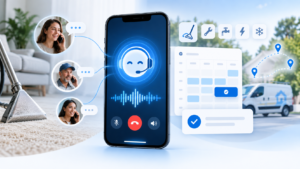
Most AI phone systems can answer a call. That is not the hard part anymore. The hard part is getting the AI to understand what the customer is actually asking for, what service category it belongs to, which follow-up questions matter, and what information the business needs before that call can turn into a real booking request.
That is where many generic AI receptionists fall apart. They can sound polite. They can take a message. They can say someone will call back. But when a real customer starts describing a job with multiple services, add-ons, special conditions, and unclear details, the AI has to do more than talk. It has to understand the structure of the business.
Nearby Booker Voice AI is being built for that exact problem. It is designed to support service categories, subcategories, service-specific questions, and real booking logic so a business is not stuck with one generic phone script for every type of call.
Related reading: Nearby Booker Voice AI, What Is Nearby Booker?, online booking for service businesses, route-aware scheduling software, nearby appointment booking, and SMS appointment reminders.
Why Categories and Subcategories Matter
A service business is rarely one simple service. A carpet cleaning company may offer carpet cleaning, stairs, upholstery cleaning, pet odor treatment, protector, area rugs, tile and grout cleaning, dryer vent cleaning, air duct cleaning, and emergency water extraction. Each of those services may need different questions, different pricing logic, different appointment lengths, and different rules.
That is where categories and subcategories matter. A category is the main type of service. A subcategory is the more specific service or option inside that category. For example, “upholstery cleaning” might be the main category, while “sofa,” “loveseat,” “sectional,” “chair,” and “ottoman” are subcategories. The AI should not treat all of those as the same thing.
A customer who says, “I need my couch cleaned” may need a different follow-up than a customer who says, “I have a large sectional with pet odor.” A good AI receptionist needs to recognize the difference, ask the right questions, and organize the details in a way the business owner can actually use.
The Problem With Generic AI Phone Scripts
Generic AI phone systems usually work from a broad script. They can answer basic questions, collect a name, take a phone number, and maybe ask what service the customer needs. That may be enough for a very simple business, but it is not enough for many local service businesses.
The problem shows up when the caller does not use perfect service names. Customers do not always know your categories. They do not always know your pricing structure. They may not know whether something is an add-on, a separate service, a special condition, or a service you do not offer at all.
A carpet cleaning customer might say, “I have three rooms, stairs, a couch, and my dog had an accident in the family room.” That single sentence may involve carpet cleaning, stair cleaning, upholstery cleaning, pet odor treatment, possible enzyme treatment, and maybe a larger conversation about whether the contamination is topical or deeper. A generic AI script can easily flatten all of that into one vague message.
Nearby Booker Voice AI is designed to do better by following the structure of the actual services inside the business.
Example: Carpet Cleaning Categories
Carpet cleaning is a strong example because the customer’s wording is often messy. Some customers talk in rooms. Some talk in square footage. Some talk about stains. Some talk about pets. Some call because they are moving out. Some need the whole house cleaned. Some only need stairs or one room touched up.
With category-aware Voice AI, the conversation can be handled more intelligently. If the customer asks for carpet cleaning, the AI can collect room count, approximate size, square footage, areas included, stairs, hallways, landings, and special concerns. If the customer mentions pet odor, the AI can shift into odor-related follow-up questions instead of treating it like ordinary carpet cleaning.
That matters because not every carpet cleaning job is the same. A basic maintenance cleaning is different from a urine contamination job. A small hallway is different from a large finished basement. A full-house cleaning is different from one bedroom and stairs. The AI needs to understand which path the conversation should follow.
Example: Upholstery Cleaning Subcategories
Upholstery cleaning is another perfect example of why subcategories matter. A customer may say “couch,” but that can mean several different things. It could be a loveseat, a standard sofa, a sectional, a recliner, a chair, or multiple pieces. The business may price those differently, schedule them differently, or ask different questions depending on the item.
A basic AI might only capture, “Customer wants upholstery cleaning.” That is not enough. The business still needs to know what item is being cleaned, how large it is, whether there are cushions, whether there are stains, whether there is pet odor, and whether the upholstery is part of a larger carpet cleaning appointment.
Nearby Booker Voice AI can support that kind of subcategory logic. If the customer says sectional, the AI can treat that differently than a dining chair or ottoman. If the customer says couch and loveseat, the AI can collect both instead of forcing the caller into one vague upholstery bucket.
Example: Pet Odor and Stain Treatment
Pet odor is not just another stain. For carpet cleaners, it can completely change the conversation. A customer may say, “My dog had an accident near the couch,” but the business may need to know whether it happened once, whether it is an ongoing issue, how large the affected area is, whether the odor is strong, and whether the customer expects odor removal or basic cleaning.
This is where Voice AI becomes valuable. Instead of giving every caller the same script, the AI can recognize that pet odor belongs to a specific service path. It can ask follow-up questions that match the subcategory and help the business understand the job before the appointment is accepted.
For example, the AI might ask whether the issue is a small spot, multiple areas, or a larger contamination problem. It can also help explain that odor treatment may be separate from standard cleaning, depending on how the business has configured its service information.
Example: Area Rugs, Pickup, and Drop-Off Rules
Area rugs are another service where category descriptions matter. A customer might ask, “Do you clean rugs?” But the business may have specific rules. Maybe rugs are pickup and drop-off only. Maybe certain rug types are not cleaned on-site. Maybe pricing depends on size. Maybe the customer needs to bring the rug in or schedule a pickup.
A generic AI receptionist might answer too broadly and create confusion. A category-aware AI can use the business’s service description to explain the rules clearly. If the area rug category says pickup and drop-off only, the AI should not accidentally offer an in-home rug appointment as if it were normal carpet cleaning.
That is a major difference. The AI should not only know the name of the service. It should understand the instructions attached to that service and apply them across the related subcategories.
Example: Tile and Grout Cleaning
Tile and grout cleaning has its own information needs. The business may need to know the approximate square footage, room type, floor condition, grout condition, whether it is a shower, whether sealing is requested, and whether furniture or appliances are involved.
If a caller says, “I need my kitchen tile cleaned,” that should trigger a different conversation than carpet cleaning or upholstery cleaning. The AI should not ask about bedrooms and stair counts when the customer is talking about tile. It should ask questions that make sense for tile and grout cleaning.
This is where service-specific logic makes the AI feel less robotic. It does not just keep asking generic questions. It follows the customer into the correct service path.
Example: Dryer Vent and Air Duct Cleaning
Some businesses offer services that are not priced or scheduled like the main service. Dryer vent cleaning and air duct cleaning may need different appointment lengths, different technician skills, different equipment, and different customer questions.
A caller asking about dryer vent cleaning may need to provide details about the home, vent location, access, symptoms, or whether the dryer is taking too long to dry. A caller asking about air duct cleaning may need to answer questions about the number of vents, home size, system access, or whether there are indoor air quality concerns.
Nearby Booker Voice AI can support these different service paths instead of trying to force everything into the same carpet cleaning script. That is important for businesses that offer multiple services but do not want the phone AI to make everything sound the same.
Subcategories Help the AI Ask Better Questions
The biggest advantage of subcategories is that they let the AI ask better questions. The AI does not need to ask every possible question on every call. It only needs to ask the questions that matter for the service the customer is talking about.
If the customer wants carpet cleaning, the AI can ask about rooms, square footage, stairs, and problem areas. If the customer wants upholstery cleaning, the AI can ask what furniture pieces are involved. If the customer wants pet odor treatment, the AI can ask about the affected area and severity. If the customer wants area rug service, the AI can explain pickup, drop-off, size, and service rules.
This makes the call feel more natural. It also keeps the customer from getting frustrated by irrelevant questions.
Subcategories Help the Business Get Cleaner Booking Requests
A vague phone message is not the same as a clean booking request. If the AI only tells the business, “Customer wants cleaning,” the owner still has to call back and start over. That defeats the point of using Voice AI.
With categories and subcategories, the AI can help organize the customer’s request before it reaches the business owner. The business can see whether the customer wants carpet cleaning, upholstery, stairs, pet treatment, tile, area rugs, dryer vent cleaning, or another specific service.
That means the owner gets better information, the customer has a smoother experience, and the appointment request is more useful from the start. This is especially important when Voice AI connects with online booking for service businesses, because better service details lead to better scheduling decisions.
Subcategories Can Support Add-Ons and Extras
Real service calls often include extras. A carpet cleaning customer may start with three rooms and then add stairs. Then they might ask about a couch. Then they may mention pet odor. Then they may ask about protector. A good AI receptionist should not fall apart when the customer adds another service.
Nearby Booker Voice AI is being built to support multi-service conversations. That matters because customers do not always organize their requests in the same order as your booking form. They may remember extra services halfway through the call. They may ask whether something can be added. They may say they are done and then remember one more thing.
The AI should be able to track the conversation, preserve the details already collected, and add the extra service without making the caller start over.
Why This Matters for Carpet Cleaners
Carpet cleaners deal with some of the messiest service conversations because customers describe their needs in normal household language. They say “family room,” “hallway,” “stairs,” “dog smell,” “couch,” “spots,” “traffic lanes,” “basement,” “moving out,” or “just the bad areas.” They do not usually speak in clean software categories.
That is exactly why category and subcategory support matters. The AI can listen for the customer’s normal words and help map them to the correct service structure. A customer does not need to know whether pet odor is an add-on, a subcategory, or a special treatment. They just need to explain the problem. The AI can help guide the rest.
This makes Nearby Booker Voice AI especially useful for carpet cleaning businesses, because the phone call often contains the information needed to quote, schedule, or decide whether the job needs a human review.
Why This Matters for Other Service Businesses
This same idea applies far beyond carpet cleaning. A junk removal company may need subcategories for single item pickup, garage cleanout, appliance removal, construction debris, or full property cleanout. A mobile detailer may need subcategories for interior detail, exterior wash, full detail, ceramic coating, pet hair removal, or oversized vehicles.
A pest control company may need different service paths for ants, spiders, rodents, wasps, mosquitoes, bed bugs, or preventative treatment. An HVAC company may need separate paths for tune-ups, no heat, no cooling, installation, indoor air quality, emergency calls, or maintenance plans.
Every service business has its own structure. Voice AI becomes more useful when it can follow that structure instead of forcing every caller through the same script.
Voice AI Should Explain Service Rules Clearly
Sometimes the most important part of a category is not the price or the appointment length. It is the rule attached to it. A business may only offer certain services in certain areas. Some services may require approval. Some may require a minimum charge. Some may be pickup only. Some may not be available on weekends. Some may need photos or a custom estimate.
Nearby Booker Voice AI can use category descriptions and service information to help explain those rules clearly. That keeps the AI from accidentally promising something the business does not offer or booking a job that should have been handled differently.
This is important because AI should not just sound helpful. It should be accurate, controlled, and aligned with the way the business actually operates.
Voice AI Should Know When to Transfer or Take a Message
Not every call should be handled automatically. Some calls are too complicated, too urgent, or too sensitive for a fully automated flow. A complaint, a large commercial job, an emergency, or an unusual request may need a human.
That is why the best Voice AI workflow is not about forcing automation on every caller. It is about handling what can be handled, collecting useful information, and knowing when to route the conversation differently. The AI should support the business owner, not trap the customer inside a script.
With the right setup, Voice AI can answer common questions, collect service details, support booking requests, and still allow the business to step in when needed.
Better Service Details Create Better Scheduling
Voice AI is not just about the phone call. The service details collected during the call can affect the entire schedule. A three-room carpet cleaning job is different from a whole-house cleaning with stairs, pet odor treatment, and upholstery. A small upholstery job is different from a large sectional and protector. A tile cleaning job may need different equipment and timing than carpet cleaning.
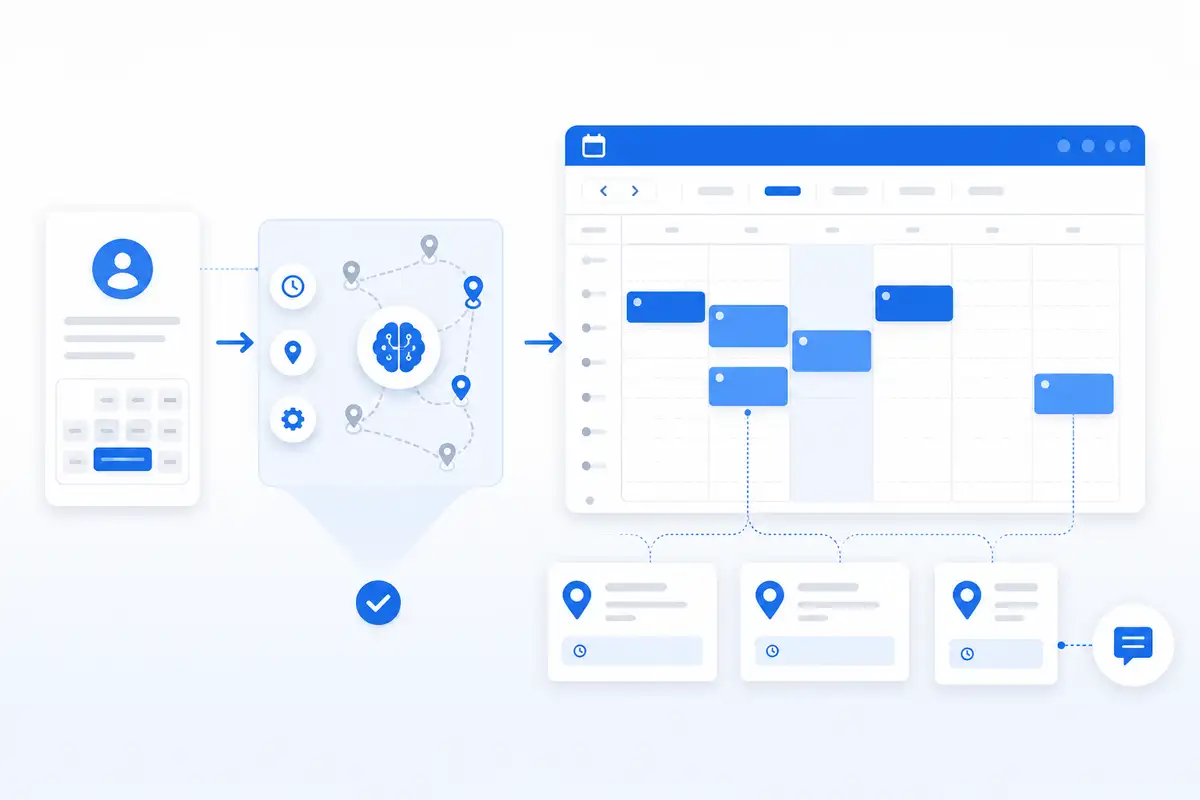
When the AI understands categories and subcategories, the scheduling system can receive cleaner information. That matters for appointment length, service assignment, technician planning, reminders, and route-aware scheduling.
This connects directly with route-aware scheduling software and nearby appointment booking. The better the service information, the easier it is to build a schedule that actually makes sense.
Voice AI Should Feel Like It Understands the Business
Customers can tell when an AI is just following a generic script. They can also tell when the conversation feels connected to the service they actually need. When the AI asks relevant questions, explains service rules correctly, and remembers the details the customer already provided, the call feels more useful.
That is the goal of Nearby Booker Voice AI. It is not just to answer the phone. It is to help the business have better phone conversations without the owner having to stop working every time the phone rings.
Categories and subcategories are a big part of that. They give the AI a structure to follow, and they give the business more control over how different services are handled.
Nearby Booker Voice AI Is Built for Real Service Conversations
Real service calls are not clean. Customers jump around. They ask questions out of order. They describe services in their own words. They add extras. They forget details. They ask about things that may or may not be offered. They need guidance.
Nearby Booker Voice AI is being built for that real-world mess. By supporting categories, subcategories, service descriptions, add-ons, and service-specific questions, it can help turn normal customer conversations into cleaner booking requests.
For carpet cleaners and other local service businesses, that can mean fewer missed calls, fewer vague messages, better service details, and a stronger path from phone call to appointment.
That is the difference between a generic AI answering service and an AI receptionist built for real service businesses.
FAQ
What are service categories in Voice AI?
Service categories are the main types of services a business offers, such as carpet cleaning, upholstery cleaning, tile and grout cleaning, dryer vent cleaning, or junk removal. Nearby Booker Voice AI can use categories to guide the conversation and ask more relevant questions.
What are service subcategories?
Subcategories are more specific services or options inside a main category. For example, upholstery cleaning may include sofas, loveseats, sectionals, chairs, and ottomans. Subcategories help the AI collect cleaner job details.
Why do subcategories matter for carpet cleaners?
Subcategories matter because carpet cleaning customers often request multiple services in one conversation, such as rooms, stairs, upholstery, pet odor treatment, and protector. The AI needs to understand those details instead of treating every call like a generic cleaning request.
Can Nearby Booker Voice AI ask different questions for different services?
Yes. Nearby Booker Voice AI is designed to support service-specific questions so the conversation can change depending on whether the customer needs carpet cleaning, upholstery, pet treatment, tile and grout, dryer vent cleaning, or another service.
Can Voice AI handle add-ons and extras?
Nearby Booker Voice AI is being built to support multi-service conversations, including add-ons and extras. That helps customers explain everything they need without starting the booking process over.